top of page


Mind the Gap

Core Idea
The project is built around the idea that space can behave incorrectly. Environments bend, overlap, and reconnect in ways that defy Euclidean logic, creating places that feel unstable yet internally consistent. Progress comes from learning how the space functions, not from mastering tools or enemies.
Overview
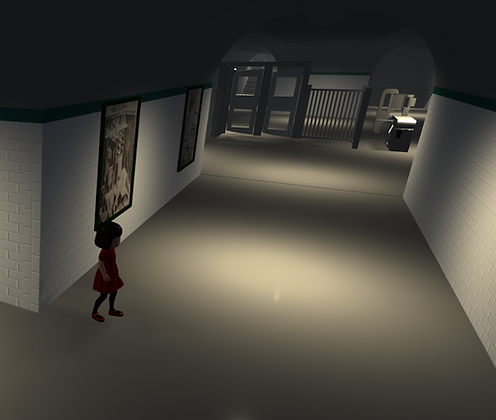
“Mind the Gap” is an experimental exploration game set in a distorted version of the Paris Metro and catacombs. The game explores liminal space, disorientation, and unfamiliar systems, using space itself as the primary mechanic rather than combat, objectives, or narrative exposition.

Spacial and 4D mechanics
At the heart of the game is a hidden fourth spatial dimension. By shifting perspective and position, players can reveal structures that do not exist in conventional 3D space. Walls become passages, distances collapse, and familiar locations transform when viewed from the “wrong” angle.
Player experience
The game is designed to evoke uncertainty and slow understanding. Players are capable but never fully confident, encouraged to observe carefully, hesitate, and experiment. Navigation replaces challenge, and comprehension replaces progression.

Narrative Approach
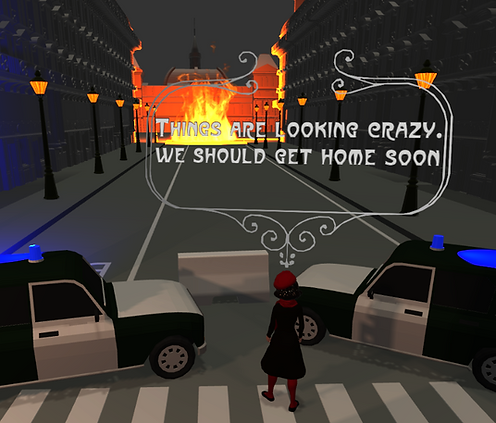
There is no explicit story or narration. Meaning emerges through atmosphere, architecture, and repetition. The setting reflects themes of being lost, foreignness, and misinterpretation, spaces that are navigable, but never fully understood.
Project Focus
“Mind the Gap” is an ongoing research-driven project exploring non-Euclidean level design, 4D spatial logic, and perception-led gameplay. It functions both as a playable experience and as a technical and design investigation into how games can represent impossible space.

bottom of page